Before you bring a costume prop anywhere, read that event’s current prop or weapons policy. Conventions, schools, theaters and venues each write their own rules, and many revise them every year, so what was fine last time, or at another event, may not be fine now. Most policies cover the same ground: no real or realistic weapons, limits on size and materials, a check-in desk that inspects and tags props, and conduct rules such as no swinging. If you know your prop’s assembled length and material, you can answer most questions in a minute.
The common types of prop rules
Policies are worded differently, but they tend to fall into these categories. Use the table to know what to look for, then read the actual text for your event.
| Rule type | What it usually covers | How to prepare |
|---|---|---|
| Real weapons and sharp items | Real blades, firearms, ammunition, sharpened metal | Bring props only, and know what yours is made of. |
| Realistic replicas | Props that could be mistaken for real weapons, especially firearms | Fantasy designs are usually easier to approve than realistic ones; check the wording. |
| Size and length limits | Maximum length or height of staffs, scythes and other long props; sometimes wingspans and backpieces | Measure the prop assembled, tip to tip, including any topper or blade. |
| Materials | Which materials are allowed, such as foam, plastic, cardboard or wood, and whether metal is banned | Have the material handy, for example a saved product page. |
| Inspection and peace-bonding | A desk where staff check props and mark approved ones | Leave time for the line and keep the prop where you can reach it. |
| Conduct | No swinging, pointing at people, mock fights outside designated areas, or blocking walkways | Carry the prop upright and pose only where there’s room. |
| Venue and building rules | Rules set by the convention center, hotel, school or theater, which can be stricter than the event’s own | Expect bag checks and follow whichever rule is stricter. |
Reading a prop policy: terms to look for
Prop policies are short, but a few words carry most of the meaning. When you read yours, look for these:
- Functional: anything that can cut, fire, or launch something. Functional items are the most commonly banned category, toy launchers included.
- Realistic or replica: judged by how the prop looks, not what it’s made of. This is the most subjective category, and the inspection desk usually makes the call.
- Length or size limit: check whether it’s measured with the prop assembled and whether toppers and blades count. Assume they do unless the policy says otherwise.
- Sheathed, holstered or carried: rules about what you do with a prop between photos, such as keeping it in a sheath or holder or carrying it upright, rather than waving it around.
- At staff discretion: the people at the desk have the final say, even if your prop meets every written rule. Be polite, and have your backup plan ready.
What is peace-bonding?
Peace-bonding is the inspection step many conventions use for props. You bring the prop to a designated desk, staff look it over against the policy, and approved props get a visible marker such as a colored tie, tag or sticker. The marker tells security and other staff that the prop has already been checked. Keep it on for the whole event, and don’t move it to a different prop. If you leave and come back, or switch costumes, you may need to go through the desk again.
Before you go: a prop checklist
- Find the event’s current prop or weapons policy, often in the FAQ, code of conduct or costume guidelines, and check the date on it.
- Measure the prop assembled, from tip to tip, in inches and centimeters.
- Note what it’s made of and roughly what it weighs.
- Look for points and edges that could raise questions, even on plastic, such as a blade tip or a spiked end cap.
- Take a clear photo of the prop next to a tape measure, in case you need to ask the organizers in advance.
- Email the organizers if your prop is close to a limit or the policy is unclear, and save their reply.
- Pack a bag or tube for carrying the pieces between your car, hotel and the venue.
- Plan a backup: where you’ll leave the prop if it isn’t approved, such as your car, hotel room or a coat check.
- Arrive early enough for the inspection line.
How our costume props measure up
These details are what staff typically ask about. All three are plastic, screw together by hand and come apart for carrying.
| Prop | Assembled length | Pieces | Material | Worth mentioning at check-in |
|---|---|---|---|---|
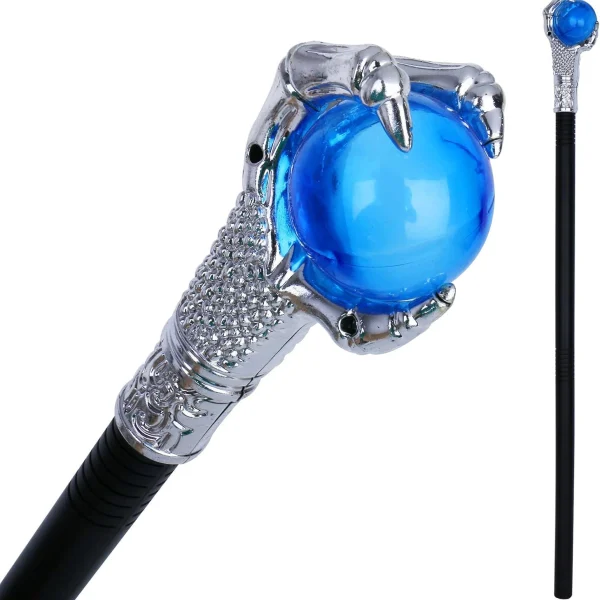
| Blue orb wizard staff | 30.7 in | 3 | Plastic | Decorative, not load-bearing, no electronics |
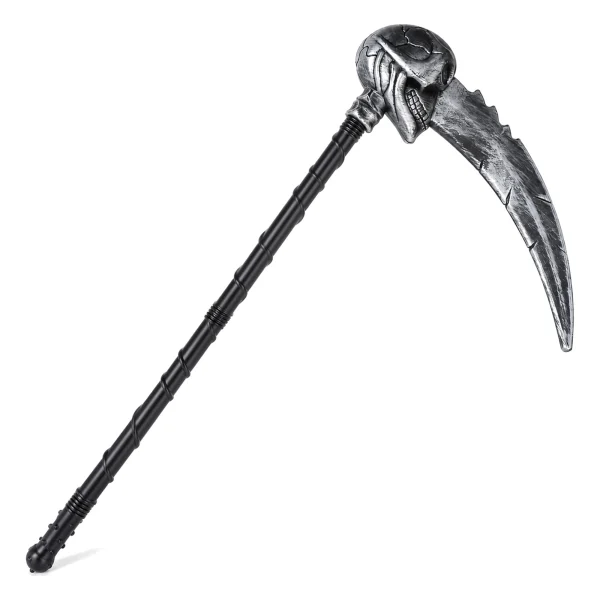
| Azude skull scythe | About 33 in, 14 in wide | 4 | Plastic | Curved faux blade and spiked end knob; made for posing, not swinging |
| Cobra-head snake cane | About 33.2 in | 3 | Plastic | Decorative only; not a mobility aid |
The blue orb wizard staff and the cobra-head snake cane are fantasy designs with no blade. The 33-inch skull scythe has a faux blade, and blade shapes are the kind of thing some policies call out, so it’s the one to check most carefully against your event’s wording. For choosing between scythe styles, see the grim reaper costume guide; for staff lengths by wearer height, see how to choose a wizard staff.
Schools: Halloween parades, spirit days and class parties
Schools set their own costume rules, and many limit or ban weapon-like accessories at Halloween events, including toy ones. A scythe may be treated differently from a wizard staff or a cane even when both are plastic. Ask the teacher or the event organizer before the day, not at the classroom door. If props are allowed, label each piece with your child’s name, send it disassembled in a bag, and remind your child that props are for carrying and photos, not play fighting.
School plays and community theater
For a production, the director or stage manager decides which props are used and how. Ask before buying, since they may want a specific length or color for the lighting, or may need every prop to match a design. Bring props to rehearsal early so actors can practice entrances and crowd scenes, and agree on a spot on the props table where each piece lives offstage. For a full school-play costume worked out with quick fixes for show day, see the Pinocchio costume for a school play guide.
Parties, haunted attractions and public places
Private parties are up to the host, but bars, restaurants, haunted attractions and theme parks may have their own costume rules, and some don’t allow costume props at all. Between venues, carry props in a bag rather than assembled in your hand; even an obviously fantasy prop can startle people on a sidewalk or on public transit. If you’re flying, check the TSA’s current guidance on toy and replica items and your airline’s baggage rules well before your trip.
Prop etiquette in a crowd
- Carry it upright and close to your body. A 33-inch prop held at arm’s length reaches nearly 5 feet from you.
- Turn slowly. Long props and wide blades catch people when you spin around for a photo.
- Never point a prop at anyone, even as a joke.
- Pose out of the walkway, ideally where the event has set up photo areas.
- Don’t lean on decorative staffs or canes; they’re not built to carry body weight.
- Don’t leave props unattended. An unattended prop can cause a security response.
Browse staffs, scythes and canes in costume props, or see more ideas for performers under cosplay and stage plays.
Frequently asked questions
What does peace-bonding mean at a convention?
It's an inspection step. Staff check your prop against the event's policy and mark approved props with a visible tag, tie or sticker. Keep the marker on for the whole event, and expect to go through the desk again if you switch props.
Can I bring a plastic scythe to a convention?
It depends on the event. Some allow plastic scythes after inspection, some have length limits it may exceed, and some restrict blade shapes. Measure it assembled and read the current policy, or email the organizers with a photo.
Is there a standard maximum prop length at conventions?
No. Each event sets its own limits, if it has any, and they change. Measure your prop tip to tip, including the topper or blade, and compare it with your event's published number.
Do I have to take an obviously fake prop to the check-in desk?
If the policy says all props must be checked, yes. Staff decide what counts, and an unchecked prop can be turned away later even if it's clearly a toy.
Can kids bring costume props to school on Halloween?
Only if the school allows it. Many schools limit weapon-like accessories, even toy ones. Ask the teacher or organizer in advance, and send approved props labeled and disassembled in a bag.
What should I do if my prop isn't approved?
Follow the staff's instructions and take it back to your car, hotel room or a coat check if one is offered. That's why it helps to plan a backup before you arrive.
Can I use a costume staff as a walking cane at a convention?
No. Decorative costume staffs and canes aren't built to carry body weight. If you need a mobility aid, bring a real one and carry the costume prop separately.