Guitar pick thickness is the gauge printed on the pick in millimeters. Picks under about 0.60 mm are thin and flex for strumming, picks around 1.0 mm and thicker are heavy and stiff for single notes, lead and bass, and the range between is medium. If you have no preference yet, start near 0.70 mm.
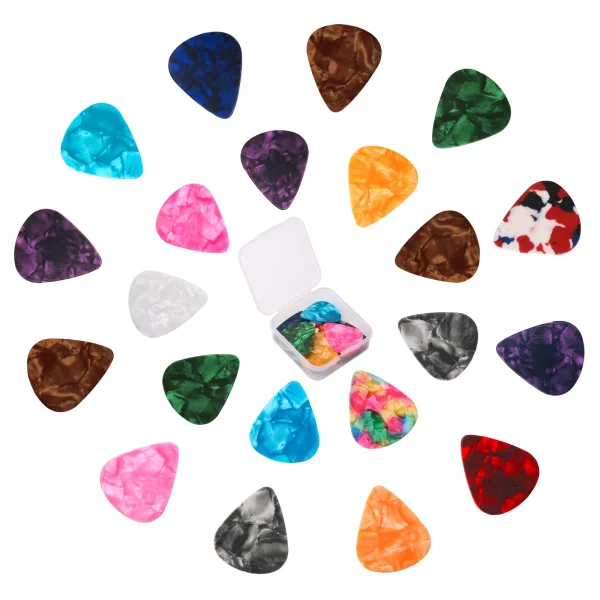
The words thin, medium and heavy are not a standard, so compare the millimeter figure instead of the label. Our Olen guitar picks variety pack has 7 picks each at 0.46, 0.71 and 0.96 mm, labeled thin, medium and heavy, so you can hear the difference on the same song.
Guitar pick thickness chart in mm
Thin guitar picks measure under about 0.60 mm, medium picks about 0.60 to 0.80 mm, and heavy picks about 1.0 mm and up. Picks between 0.80 and 1.0 mm are called medium by some brands and heavy by others.
| Gauge | Thickness | Feel | Sound and typical use | In the Olen sampler |
|---|---|---|---|---|
| Extra thin | Under about 0.45 mm | Very floppy | Light and bright with audible pick click; gentle strumming | None |
| Thin | About 0.45 to 0.60 mm | Flexes across all six strings | Bright, even strums; acoustic chords, rhythm, ukulele | 0.46 mm |
| Medium | About 0.60 to 0.80 mm | Some give, holds its shape on single strings | Balanced; strumming plus melodies, the usual first pick | 0.71 mm |
| Medium-heavy | About 0.80 to 1.0 mm | Stiff, little flex | Fuller single notes; electric rhythm and riffs | 0.96 mm (labeled heavy) |
| Heavy | About 1.0 to 1.5 mm | Rigid | Firm, precise attack; lead lines, metal, bass | None |
| Extra heavy | Over about 1.5 mm | Rigid, little pick noise | Warm, full single notes; jazz and bass | None |
D’Addario’s pick guide describes thinner picks as flexible and forgiving for strumming, and thicker picks as louder, harder and more precise in their attack. It also notes that a change of as little as 0.2 mm can be felt and heard. The three Olen gauges step up 0.25 mm at a time (0.46, 0.71, 0.96 mm), so each step is a difference you will notice.
Why the same thickness gets different labels
A 0.96 mm pick is “heavy” in our sampler but falls in the 0.60 to 1 mm range D’Addario’s guide calls medium, so compare millimeters.
| Label | Olen sampler | D’Addario Classic Pearl celluloid | D’Addario guide range |
|---|---|---|---|
| Thin or light | 0.46 mm | 0.50 mm (Light) | Under about 0.60 mm |
| Medium | 0.71 mm | 0.70 mm | Roughly 0.60 to 1 mm |
| Heavy or thick | 0.96 mm | 1.0 mm | About 1.0 mm and up |
The mediums line up almost exactly; the ends don’t. If a teacher or a lesson video names a gauge by word only, ask for the number, or bracket it: try the pick just under and just over the figure you’re given.
Which pick thickness for acoustic, electric, bass and ukulele?
D’Addario suggests starting around 0.60 mm for acoustic, 0.73 to 0.88 mm for electric, and 1.0 to 1.5 mm for lead guitar or metal.
| Style or instrument | Suggested thickness (D’Addario) | Closest Olen pick |
|---|---|---|
| Acoustic strumming, folk, pop | About 0.50 to 0.73 mm | 0.71 mm, or 0.46 mm for a lighter strum |
| Beginner, any style | About 0.70 to 0.80 mm | 0.71 mm |
| Electric rock and blues | About 0.73 to 0.88 mm | 0.71 and 0.96 mm bracket the range |
| Lead guitar and metal | About 1.0 to 1.5 mm | 0.96 mm, just under |
| Jazz, fusion, acoustic flatpicking | About 1.0 to 2.0 mm | 0.96 mm, just under |
| Bass | 1.0 to 2.0 mm | 0.96 mm, just under |
| Ukulele | 0.40 to 0.60 mm, or felt | 0.46 mm |
| Mandolin and banjo | Medium-heavy | 0.96 mm |
Acoustic
For strumming chords, the flex of a thin or light-medium pick evens out strums and forgives a sloppy angle, at the cost of more click and less punch on single notes. If you also play melodies or bass runs, the 0.71 mm is the easier compromise. D’Addario adds that celluloid picks with rounded tips, like the three tips on each Olen pick, soften the attack and reduce pick noise on acoustic.
Electric
A stiff pick doesn’t bend and spring back between notes, so timing stays predictable on riffs and alternate picking. Use the 0.71 and 0.96 mm picks to bracket D’Addario’s 0.73 to 0.88 mm electric range and keep whichever feels closer to right.
Bass, ukulele and mandolin
D’Addario puts bass picks at 1.0 to 2.0 mm, so the 0.96 mm is the one to try from this set; it sits just under that range, and if you like it, a thicker pick is the next step. For ukulele, D’Addario suggests very thin picks of 0.40 to 0.60 mm or felt on nylon strings, which makes the 0.46 mm the match. Fingerpicks and thumb picks are a different tool, and a flat-pick set doesn’t replace them.
What thickness should a beginner use?
Start with a medium pick around 0.70 mm: D’Addario recommends 0.70 to 0.80 mm for beginners, and the 0.71 mm Olen pick falls in that range.
- If you mostly strum chords and the 0.71 mm catches on the strings or sounds harsh, drop to the 0.46 mm.
- If single notes feel sloppy because the pick bends, move up to the 0.96 mm.
- If both feel fine, keep the 0.71 mm and, as D’Addario advises, stick with one shape for a few weeks so your grip settles.
Kids who play guitar use the same picks as adults, and the thin gauge is forgiving for small hands learning to strum. Picks are small, so supervise younger children and keep spares out of reach.
How to compare three gauges in one practice session
Play the same four-chord progression and the same short single-note line with each gauge, on one guitar, changing nothing but the pick.
- Strum the progression with the 0.46 mm, then the 0.71 mm, then the 0.96 mm.
- Play the single-note line or a scale with each one, at a tempo you can manage cleanly.
- Record each pass on your phone. A pick sounds different from in front of the guitar than from behind it.
- Note which pick twists in your fingers, which one misses strings, and which one sounds closest to what you want.
Hold each pick the same way, between the pad of your thumb and the side of your index finger with the same amount of tip showing. Less tip makes any pick feel stiffer; more tip lets it flex. If the 0.96 mm feels harsh on chords, loosen your grip before you rule it out.
Many players end up using two gauges, a thinner one for strumming songs and a thicker one for lead parts. D’Addario suggests building a small toolkit of 2 to 4 picks as your technique develops, and 7 of each gauge leaves enough for your case, your pocket and spares.
How to hold and use a guitar pick properly
Rest the pick on top of your index finger with a little less than 1/2 in (about 1 cm) past the fingertip, then cover it with your thumb.
That is the method Taylor Guitars teaches: curl your hand into a relaxed fist, as if around a coffee mug, point the pick the same way as your index finger, and lower your thumb over most of the pick so the point sits perpendicular to it. Taylor recommends a grip that is neither loose nor tight, because a loose pick drops and squeezing hard can cause cramping. It also says there is technically no single right way to hold a pick, so treat this as the starting grip and adjust from there.
- If the pick snags on the strings, too much point is showing. Pull it back toward the fingertip.
- If the pick spins in your fingers, press with the flat of the thumb before you squeeze harder. Smooth celluloid, which D’Addario notes can feel slippery, grips better with dry fingers.
- For strumming, keep the wrist loose and brush the tip across the strings rather than digging in. The 0.46 mm pick flexes more the more tip you show.
- For single notes, Taylor describes alternate picking, switching between a downstroke and an upstroke on each new note, as the economical way to move. The stiffer 0.96 mm holds its shape for this with the least tip showing.
Triangle shape, celluloid and when to replace a pick
Each Olen pick is a 1.18 x 0.78 in (about 30 x 20 mm) celluloid triangle with three rounded tips you can rotate as one wears.
It is a standard-size triangle, not an oversized or thumb pick, and the wide body gives your thumb a broad area to hold.
Celluloid
D’Addario describes celluloid as a classic pick material with a bright, balanced response, notes that its smooth surface can feel slippery to some players, and says celluloid picks were introduced in the early 1900s as a substitute for tortoiseshell. NOAA’s CAMEO Chemicals database describes celluloid as cellulose nitrate with camphor or another plasticizer, and classes it as a flammable material that may be ignited by heat, sparks or flames. Keep picks away from open flames, and don’t leave them on a hot car dashboard.
When to replace a pick
Replace a pick when the tip rounds over or chips, or when notes lose clarity, which matches D’Addario’s guidance. With a triangle, use all three tips before you retire it. The clear case in the Olen set keeps the three gauges together, and the pearloid colors help you tell them apart.
How to store guitar picks and use a pick holder
Store picks flat in a closed case, sorted by gauge and away from heat; the clear case in the Olen set holds all 21 picks together.
To use the case as a pick holder, keep the 3 gauges in separate stacks (the pearloid colors make them easy to sort), take out only the pick you are playing, and put it back before the guitar goes away. Keep the case in your gig bag or beside your practice spot so a spare is always in reach. A quick count after a lesson tells you if one went missing: the full set is 21.
- Keep heat away. As noted above, celluloid is flammable, so the case belongs in a drawer or a gig bag, not on a dashboard, radiator or sunny windowsill.
- Separate worn picks. Put a pick with all 3 tips worn somewhere else so it doesn’t drift back into the case.
- Clip-on and stick-on holders for a guitar or mic stand keep 1 or 2 picks at hand during a song; the case holds the rest.
- Around small children, keep the case closed and out of reach, since picks are small.
A gauge sampler as a gift for a new player
A 21-pick sampler in three gauges suits someone who has just started guitar and doesn’t know their preferred thickness yet.
Tie the case with a strip of happy birthday gift ribbon for a birthday, and check how much ribbon a small gift needs before you cut. For more ideas, see our stocking stuffers for guitar players or browse home and everyday finds.
Frequently asked questions
What guitar pick thickness should a beginner use?
About 0.70 mm. D'Addario recommends 0.70 to 0.80 mm for beginners because a medium pick balances flex for strumming with control for single notes. If you only strum chords, a thin pick around 0.46 mm is easier; play both for a week before you decide.
How do I choose guitar pick thickness?
Match it to what you play most: a thin pick under about 0.60 mm if you mostly strum chords, a medium around 0.70 mm if you strum and play melodies, and about 1.0 mm or thicker for lead lines and bass (0.96 mm in our set). Then try the gauge just above and just below on the same song before you settle.
How do you choose guitar picks?
Choose the thickness first, then check shape, size and material. A standard triangle like ours, 1.18 x 0.78 in (about 30 x 20 mm), gives 3 usable tips and a wide area to hold. D'Addario describes celluloid as bright and balanced but notes its smooth surface can feel slippery, so if a pick keeps sliding, try a textured or different material before changing gauge.
What thickness is a medium guitar pick?
Usually about 0.60 to 0.80 mm. D'Addario's celluloid medium is 0.70 mm and ours is 0.71 mm, but D'Addario's guide stretches its medium range up to 1 mm, so always check the millimeter figure.
Is a 0.96 mm pick medium or heavy?
It depends on the brand. We label our 0.96 mm pick heavy, and D'Addario's heavy celluloid pick is 1.0 mm, yet D'Addario's guide places everything from 0.60 to 1 mm in its medium range. Either way it is stiff enough for single notes and riffs.
Are thin or heavy picks better for acoustic guitar?
For strumming, thin to medium picks of about 0.50 to 0.73 mm are common, per D'Addario, because they flex and keep strums even. For flatpicked melodies and lead lines, some players go up to 1.0 mm or more for control.
What do 0.46 mm, 0.71 mm and 0.96 mm mean on a pick?
They are the pick's thickness in millimeters. In our variety pack, 0.46 mm is thin, 0.71 mm is medium and 0.96 mm is heavy, with 7 picks of each. A 0.38 mm pick would be thinner than any of them.
What pick thickness should I use for bass and ukulele?
D'Addario puts bass picks at 1.0 to 2.0 mm and suggests very thin picks of 0.40 to 0.60 mm, or felt, for ukulele. From our sampler, that means the 0.96 mm for bass, just under that range, and the 0.46 mm for ukulele.
Are these large guitar picks?
No. Each Olen pick is 1.18 x 0.78 in (about 30 x 20 mm), a standard-size triangle with three rounded tips, not an oversized or thumb pick.
How do I know when a pick is worn out?
The tip feels rounded or chipped, catches on the strings, or notes lose clarity. With a triangle pick, rotate to one of the other two tips first, then replace it once all three are worn.